Types of Bowling in Cricket: Pace, Swing, Seam and Spin Explained
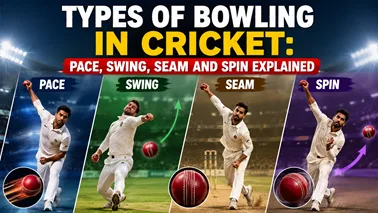
Every bowler tries to do the same thing: get the batter out or stop them scoring. But there are many ways to do it. This guide explains the main types of bowling and the deliveries you will hear about in commentary.
Pace bowling
Pace bowlers rely on speed. They are usually described by how fast they bowl:
- Fast – around 140 km/h (87 mph) and above.
- Fast-medium and medium-fast – roughly 130–140 km/h.
- Medium – slower, relying on accuracy and movement.
Swing
A swing bowler makes the ball curve in the air. With a new, shiny ball, keeping one side polished and the seam upright makes it move. An outswinger moves away from a right-handed batter; an inswinger moves in towards the stumps.
Reverse swing
When the ball gets old and rough, it can swing the opposite way, late and fast. Pakistan's fast bowlers, from Sarfraz Nawaz and Imran Khan to Wasim Akram and Waqar Younis, made reverse swing famous.
Seam
A seam bowler lands the ball on its raised seam so it changes direction off the pitch. Seam movement is strongest on grassy or damp pitches.
Key pace deliveries
- Yorker – a full ball aimed at the batter's toes or the base of the stumps; very hard to hit, especially at the end of an innings.
- Bouncer – a short ball that rises towards the batter's head or chest. Playing conditions limit how many can be bowled in an over.
- Slower ball – the same action but much less pace, to make the batter play too early.
- Cutter – the bowler drags their fingers across the ball so it grips and moves off the pitch.
Spin bowling
Spinners bowl slowly, roughly 70–95 km/h, and make the ball turn off the pitch using their fingers or wrist. Spin is most dangerous on dry, worn pitches, which is why it plays a big role in Asia and late in Test matches.
Finger spin
- Off-spin (right-arm) – turns from off to leg, into a right-handed batter.
- Left-arm orthodox – turns away from a right-handed batter.
- Doosra – an off-spinner's ball that turns the other way. Saqlain Mushtaq is credited with making it popular.
- Carrom ball – flicked out with the fingers, often by mystery spinners.
Wrist spin
- Leg-spin (right-arm) – turns from leg to off, away from a right-handed batter. Abdul Qadir and Shane Warne are among its most famous bowlers.
- Googly – a leg-spinner's ball that turns the other way, like an off-break.
- Flipper – a fast, skidding ball that stays low.
- Left-arm wrist spin – sometimes called "chinaman"; turns into a right-handed batter.
How to read a bowler's figures
Bowling figures such as 10-1-42-3 mean 10 overs bowled, 1 maiden (an over with no runs), 42 runs conceded and 3 wickets. The economy rate is runs per over: here 4.2.
Want the batter's side of the story? Read our guide to cricket batting shots.
Line and length
Most of a bowler's work is about two things: length, where the ball pitches between the bowler and the batter, and line, how far it is from the stumps.
- Good length – the batter is unsure whether to go forward or back. This is where most wickets come from in Test cricket.
- Short – the ball bounces higher; useful as a surprise, expensive if overused.
- Full – pitched up close to the batter; it invites a drive but can swing late.
- Yorker length – at the batter's feet; the most valuable length at the end of a limited-overs innings.
The line just outside off stump is often called the "corridor of uncertainty", because the batter cannot be sure whether to play or leave.
The bowling action and the 15-degree rule
In cricket the ball must be bowled, not thrown. Under ICC regulations, a bowler's elbow may straighten by up to 15 degrees during delivery. A bowler reported for a suspect action is tested at an accredited laboratory, and a bowler found to be over the limit is suspended until the action is corrected.
Bowling in each format
- Tests: patience and pressure. Bowlers bowl long spells on a good length and wait for the batter to make a mistake.
- ODIs: wickets with the new ball in the first powerplay, control in the middle overs, and variations at the end.
- T20s: every ball matters. Yorkers, slower balls and wide yorkers are the main weapons in the last overs.
Bowling terms every fan should know
- Maiden over – an over in which the bowler concedes no runs.
- Hat-trick – three wickets with three consecutive balls by the same bowler in the same match.
- Five-wicket haul – five or more wickets in one innings.
- Bowling average – runs conceded per wicket; lower is better.
- Strike rate – balls bowled per wicket; lower is better.
- Economy rate – runs conceded per over.
Frequently asked questions
What is the difference between swing and seam?
Swing is movement in the air before the ball pitches. Seam is movement off the pitch after the ball lands on its seam.
Why does reverse swing happen?
When one side of an old ball becomes rough and the other stays smoother, the ball can swing towards the shiny side, the opposite of normal swing, especially at high pace.
What is a googly?
A leg-spinner's delivery that turns the opposite way to a normal leg-break, like an off-break, which makes it very hard for the batter to read.
More cricket news
 Match Reports · Nov 1, 2026
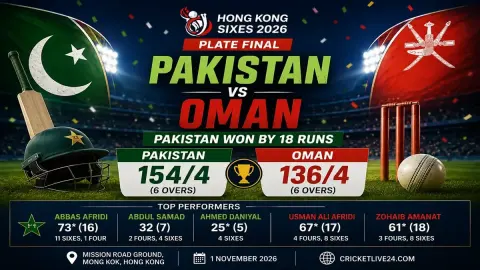
Pakistan vs Oman Hong Kong Sixes 2026 Final Scorecard
Pakistan defeated Oman by 18 runs in the Hong Kong Sixes 2026 Plate Final. Read the full match report, scorecard, top…
 Cricket News · Nov 1, 2026
Pakistan Beat Sri Lanka to Win ODI Tri-Series 2026
Pakistan defeated Sri Lanka by three wickets to win the ODI Tri-Series 2026, with Fakhar Zaman scoring a brilliant…
 Match Previews · Oct 29, 2026
Pakistan vs Sri Lanka Final Match Preview 2026: Full Details
Pakistan face Sri Lanka in the 2026 ODI Tri-Series Final in Lahore. Check match date, start time, team news, key…
Comments (0)
No comments yet. Be the first to share your view.