What Is Net Run Rate in Cricket and How Is It Calculated?
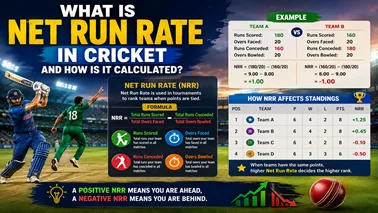
When two teams finish a tournament group with the same number of points, the one with the better net run rate (NRR) usually goes through. NRR appears on every points table, but it is often misunderstood. Here is how it works.
The formula
Net run rate is a team's scoring rate minus the scoring rate of its opponents, over the whole tournament:
NRR = (total runs scored ÷ total overs faced) − (total runs conceded ÷ total overs bowled)
A positive NRR means a team scores faster than its opponents on average. A negative NRR means it scores more slowly.
Example 1: one match
Team A scores 300 in 50 overs. Team B replies with 250 all out in 50 overs.
- Team A's scoring rate: 300 ÷ 50 = 6.00
- Rate against Team A: 250 ÷ 50 = 5.00
- Team A's NRR: 6.00 − 5.00 = +1.000
- Team B's NRR: 5.00 − 6.00 = −1.000
Overs are counted in balls, not decimals
In cricket, 40.3 overs means 40 overs and 3 balls, which is 40.5 overs in the formula, because each over has six balls. 20.4 overs becomes 20.667 overs. This small detail changes many NRR calculations.
Example 2: a quick chase
Team A scores 200 in 50 overs. Team B chases it down, making 201 in 35.3 overs (35.5 overs in the formula).
- Team B's scoring rate: 201 ÷ 35.5 = 5.662
- Rate against Team B: 200 ÷ 50 = 4.000
- Team B's NRR from this match: +1.662
Winning quickly boosts NRR, which is why teams sometimes chase hard when they need to improve their position.
The all-out rule
If a team is bowled out before using all its overs, it is counted as if it had faced its full quota of overs. So a team all out for 150 in 30 overs of a 50-over match is treated as scoring 150 in 50 overs. This stops a team from gaining NRR by losing quickly.
Rain and shortened matches
When a match is shortened and the target is revised by the Duckworth-Lewis-Stern (DLS) method, the revised target and overs are used. A match with no result does not count towards NRR at all.
NRR over a whole tournament
NRR is not the average of each match's NRR. The ICC adds up all runs and all overs from every match first, then applies the formula once. A single heavy defeat can therefore pull a team's NRR down for the whole tournament.
Quick summary
- NRR = your scoring rate minus your opponents' scoring rate.
- Convert balls to sixths of an over (40.3 overs = 40.5).
- All out = full quota of overs.
- Totals for the whole tournament, not an average of matches.
Look for NRR in points tables in our World Cup and T20 Leagues coverage.
Worked example: a whole group stage
Here is a made-up example to show how NRR works across several matches. Team A plays three 50-over matches:
| Match | Team A scored | Opponent scored | Result |
|---|---|---|---|
| 1 | 280 in 50 overs | 250 in 50 overs | Won |
| 2 | 180 all out in 40.2 overs | 181 in 38 overs | Lost |
| 3 | 301 in 48.3 overs | 300 in 50 overs | Won |
- Runs scored: 280 + 180 + 301 = 761. Overs faced: 50 + 50 (all out, so the full 50 count) + 48.5 = 148.5. Scoring rate: 761 ÷ 148.5 = 5.125.
- Runs conceded: 250 + 181 + 300 = 731. Overs bowled: 50 + 38 + 50 = 138. Rate against: 731 ÷ 138 = 5.297.
- Net run rate: 5.125 − 5.297 = −0.173.
Team A won two of its three matches but still has a negative NRR, because its two wins were close and its defeat was quick. This happens often in real tournaments.
Common mistakes
- Using 40.3 overs as 40.3. It is 40 overs and 3 balls, which is 40.5 overs.
- Averaging the NRR of each match. The ICC adds all runs and all overs first.
- Forgetting the all-out rule. A team bowled out is counted as facing its full quota of overs.
- Thinking every win raises NRR. A narrow win can lower NRR if the team was scoring much faster than its opponents before.
Frequently asked questions
Can a team with more wins have a worse NRR?
Yes. Points come first on the table, so the team with more wins stays ahead, but its NRR can still be lower than a team with fewer wins.
What does an NRR of 0.000 mean?
The team has scored runs at exactly the same rate as its opponents over the tournament.
Is net run rate used in Test cricket?
No. The World Test Championship table is decided by the percentage of points won, not by run rate.
How many decimal places are shown?
Points tables usually show NRR to three decimal places, such as +0.654.
More cricket news
 Match Reports · Nov 1, 2026
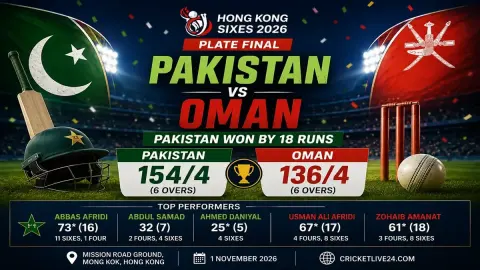
Pakistan vs Oman Hong Kong Sixes 2026 Final Scorecard
Pakistan defeated Oman by 18 runs in the Hong Kong Sixes 2026 Plate Final. Read the full match report, scorecard, top…
 Cricket News · Nov 1, 2026
Pakistan Beat Sri Lanka to Win ODI Tri-Series 2026
Pakistan defeated Sri Lanka by three wickets to win the ODI Tri-Series 2026, with Fakhar Zaman scoring a brilliant…
 Match Previews · Oct 29, 2026
Pakistan vs Sri Lanka Final Match Preview 2026: Full Details
Pakistan face Sri Lanka in the 2026 ODI Tri-Series Final in Lahore. Check match date, start time, team news, key…
Comments (0)
No comments yet. Be the first to share your view.