Cricket Batting Shots Explained: Drive, Pull, Cut, Sweep and More
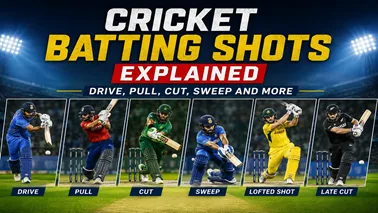
Commentators talk about cover drives, pulls and reverse sweeps all the time. This guide explains the main batting shots, when a batter plays each one and where the ball goes. Directions are for a right-handed batter; for a left-hander everything is mirrored.
Defensive shots
- Forward defence – the front foot goes forward and the bat comes down straight next to the pad to block a good-length ball. The aim is not to score but to stay in.
- Back-foot defence – the batter moves back towards the stumps to block a shorter ball.
- Leave – letting a ball outside off stump go past without playing. A good leave is an important skill in Test cricket.
Drives
Drives are played to full-length balls with a straight bat, usually off the front foot.
- Straight drive – back past the bowler.
- Cover drive – through the off side, between point and mid-off. Babar Azam's cover drive is one of the most admired in the modern game.
- On drive – through the leg side, between mid-on and mid-wicket; one of the hardest drives to play well.
- Lofted drive – a drive hit over the fielders, often for six.
Shots to short balls
- Pull – a short ball around waist height is hit across the line to the leg side, in front of square.
- Hook – like the pull, but to a ball at shoulder or head height; risky, as it can be caught on the boundary.
- Square cut – a short, wide ball is hit hard through the off side, square of the wicket.
- Upper cut – a short ball outside off stump is guided over the slips or third man; common in T20 cricket.
Leg-side and late shots
- Flick – a ball on the pads is turned with the wrists to the leg side.
- Glance – a gentle deflection of a ball on the pads, fine on the leg side.
- Late cut – the ball is played very late with an angled bat, past the slips.
Shots against spin
- Sweep – the batter kneels and sweeps the ball to the leg side with a horizontal bat.
- Reverse sweep – the same movement in the opposite direction, to the off side.
- Stepping out – moving down the pitch to reach the ball before it turns, often to hit a lofted drive.
Modern T20 shots
- Scoop or ramp – the ball is lifted over the wicketkeeper's head.
- Switch hit – the batter changes from right-handed to left-handed stance (or the reverse) as the bowler runs in.
- Helicopter shot – a whip of the wrists that sends a yorker-length ball high over the leg side, made famous by MS Dhoni.
Reading a batter's score
A score such as 85 (62) means 85 runs from 62 balls. Strike rate is runs per 100 balls: here about 137. In Tests, batters care most about time at the crease; in T20s, strike rate is everything.
See the bowler's side in our guide to types of bowling in cricket.
Footwork: front foot and back foot
Every shot starts with the feet. To a full ball, the batter moves the front foot towards the pitch of the ball and plays forward. To a short ball, the batter moves the back foot back and across to get more time. Good footwork puts the head over the ball, which is why coaches say that batting starts with the feet and the eyes, not the hands.
Choosing the right shot
- Full ball on the stumps – straight drive or on drive.
- Full ball outside off stump – cover drive, or a leave in Test cricket if it is wide.
- Short ball – pull or hook if it is at the body, cut if it is wide.
- Good-length ball – usually a defensive shot or a leave, waiting for a bad ball.
- Spinner who tosses the ball up – step out and drive, or sweep from outside off stump.
Batting terms every fan should know
- Duck – out without scoring; a golden duck is out first ball.
- Fifty and century – 50 and 100 runs in an innings; 200 is a double century.
- Not out (*) – the batter was still in when the innings ended, as in 113*.
- Batting average – runs scored per dismissal.
- Partnership – runs added by two batters while they are together at the crease.
- Nightwatchman – a lower-order batter sent in late in a day's play in a Test to protect a better batter.
Batting in each format
In Test cricket, the most important skill is staying in: leaving well, defending well and scoring from bad balls. In ODIs, batters build an innings, rotate the strike in the middle overs and attack at the end. In T20 cricket, there is little time to settle, so batters take more risks and use shots such as the scoop and the switch hit.
Frequently asked questions
What is the hardest batting shot?
Many coaches name the on drive, because the batter must keep the bat straight while the body leans towards the off side.
What is a good strike rate?
It depends on the format. Around 50 is normal in Tests, around 90 to 100 is good in ODIs, and 140 or more is good in T20 cricket.
What is the difference between a pull and a hook?
Both are played to short balls on the leg side. A pull is played to a ball around waist height; a hook is played to a ball at shoulder or head height.
More cricket news
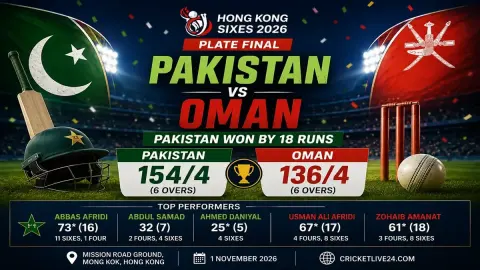 Match Reports · Nov 1, 2026
Pakistan vs Oman Hong Kong Sixes 2026 Final Scorecard
Pakistan defeated Oman by 18 runs in the Hong Kong Sixes 2026 Plate Final. Read the full match report, scorecard, top…
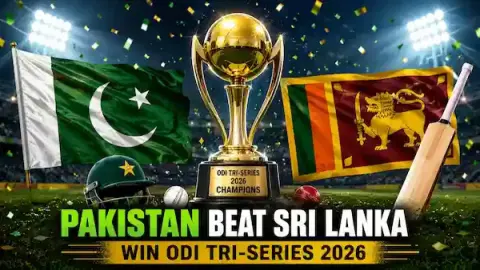 Cricket News · Nov 1, 2026
Pakistan Beat Sri Lanka to Win ODI Tri-Series 2026
Pakistan defeated Sri Lanka by three wickets to win the ODI Tri-Series 2026, with Fakhar Zaman scoring a brilliant…
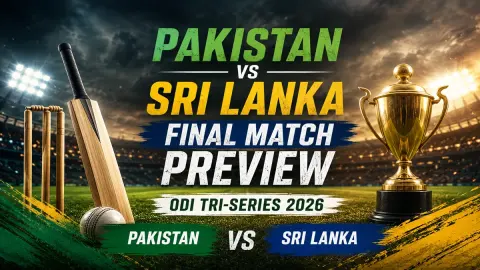 Match Previews · Oct 29, 2026
Pakistan vs Sri Lanka Final Match Preview 2026: Full Details
Pakistan face Sri Lanka in the 2026 ODI Tri-Series Final in Lahore. Check match date, start time, team news, key…
Comments (0)
No comments yet. Be the first to share your view.